The Container the Paperwork Will Not Release: How Small Mismatches Hold a Low-GI Shipment Longer Than the Ocean Crossing
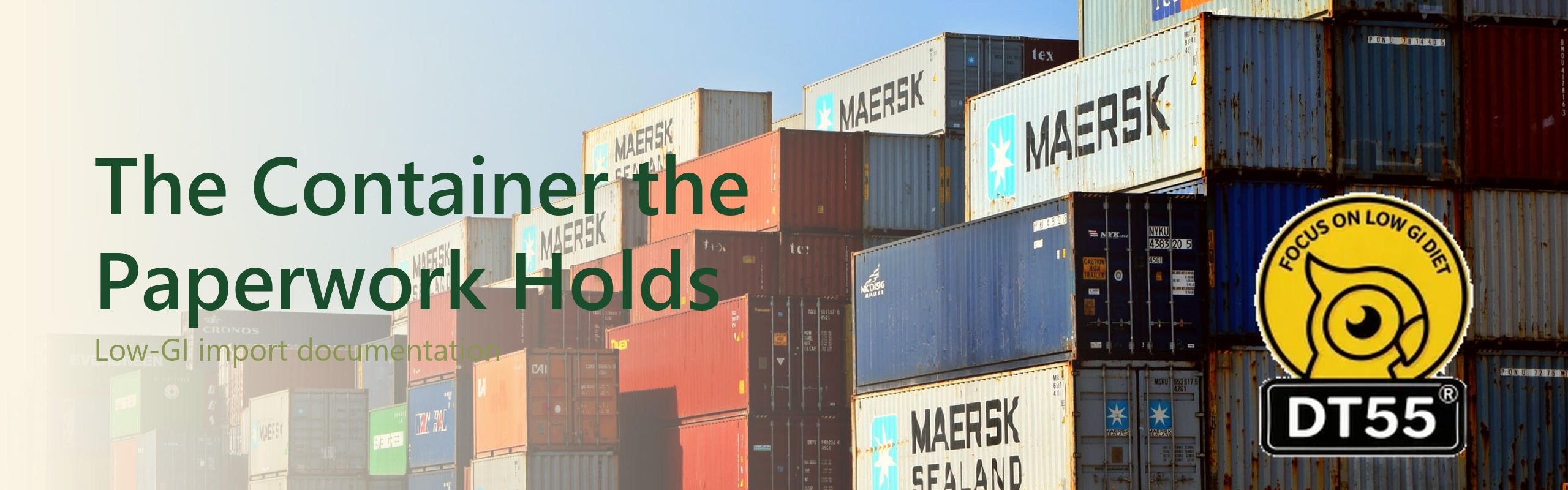
The Container the Paperwork Will Not Release: How Small Mismatches Hold a Low-GI Shipment Longer Than the Ocean Crossing
This note is for the importer whose container reached the destination port on schedule and then stayed there — not because the cargo failed an inspection, but because two documents disagree about what the cargo is. The goods are fine. The paper is not. And until the paper agrees with itself, the goods might as well not exist.
A container in international food trade is checked twice. The cargo is examined once, briefly, by people who can see it. The documents are examined many times, in detail, by people who never see it. In practice the paper twin fails far more often than the physical one — and when it fails, it fails at a desk, weeks after anyone could still fix it cheaply.
1. The shipment travels twice
The physical container makes one journey. Its documentary twin makes the same journey in parallel, and at every checkpoint somebody reads the twin instead of the box: the shipping line at loading, the port authorities at transhipment, destination customs, the destination food authority, and often the retailer's own vendor-onboarding team before a listing is even discussed.
At every one of those desks, the test is agreement. Not quality, not freshness, not compliance in the abstract — agreement. Do the documents agree with one another, and does the cargo agree with what the documents say? A container whose papers agree moves. A container where they do not stops, and stops hard, because the person who found the mismatch can usually only reject, not repair.
2. Where the mismatches actually come from
None of the classic discrepancies is exotic. They fall into five groups, and every experienced importer has met all five.
The name. The same company can arrive at a destination desk spelled three ways: abbreviated on the bill of lading, transliterated on the health certificate, expanded on the certificate of origin. Each document is correct in the language and habit of the office that issued it. Together they describe three different companies, and the terminal does not know which one owns the goods.
The ports and the dates. The discharge port changes between booking and bill of lading — a normal commercial event that nobody pushes back into the certificates. A health certificate carries an issue date earlier than the production date it claims to certify, because the application was typed from a template. Both are small. Both are fatal in the wrong queue.
The weights and the description. The packing list rounds to the case; the certificate states net weight to the gram; the half-kilogram gap becomes a formal discrepancy. The product name on the certificate follows the factory's internal name, while the label on the goods follows the brand name registered for the destination — and a desk that cannot match the two holds the container until somebody explains, in writing, that they are the same thing.
3. The chain reaction
The reason these mismatches hurt is not their size but their structure. Documents form a chain: correcting one link forces corrections into the others, because the corrected name must now appear identically on the bill of lading, the certificate of origin, the health certificate, and the commercial invoice. Authorities issue fresh originals, not photocopies. A one-word fix becomes a two-week loop of applications, stamps, and couriers.
Meanwhile the clock at the terminal does not pause. Free time is counted in days. After that, storage charges accrue on the container daily, and the shipping line's paperwork charges accrue in parallel. What began as a typographical difference becomes a line item that nobody budgeted.
In the worst cases, the goods approach the edge of the very shelf life they were packed with before a store ever sees them — which converts a documentation problem into a commercial one, and, for a short-shelf-life clean-label range, can convert it into a total loss. A note we published earlier on why one shelf-life number cannot serve every market makes that arithmetic explicit.
4. Why competent factories still get this wrong
The certificates involved are not issued by the factory. They are issued by chambers of commerce, inspection bodies, and government offices, each with its own formats, its own transliteration habits, and its own queue. The factory fills in application forms; it does not control the output. A factory can be excellent at making the product and still poor at predicting what a distant desk will do with its paperwork.
Destination requirements are also largely invisible until arrival. A factory that has issued the same document set a hundred times to one region has learned that region's habits — not the next region's. The mismatch is often discovered by an official at the destination who issued none of the documents and has no authority to fix any of them. Rejection is the only lever such a desk has, and it uses it.
The structural cause, though, is simpler: nobody compares the documents side by side before they are issued. Each document is correct in isolation. Discrepancies do not live inside documents; they live between them. And the only person positioned to look between documents — the exporter — is usually the busiest person in the chain during the exact week those documents are being produced.
5. The layer specific to a low-GI range
On top of the universal risks sits one layer that is specific to any range carrying a nutritional claim. The pack states the claim — low glycemic index, no added sugar, high fibre. The documents must not contradict it. A certificate of analysis whose values drift from what the pack says, even slightly and even legitimately, hands a destination authority a reason to open questions the shipment cannot afford.
Batch identity is the second exposure. The date codes printed on the goods must match the batch named on the certificate of analysis, and the claim must trace back to the formulation version that was actually tested. We have argued before that a GI value is an assay result tied to a specific sample and method, not a permanent attribute of a product family. The document set is where that argument becomes checkable: a desk officer who reads a claim on the pack and a report naming a different batch has, strictly speaking, found a mismatch.
Certification scope is the third. Destination authorities read a certificate's scope literally. A scope that names one product category does not automatically cover a sibling category sharing the same factory, and a buyer who assumes it does discovers the gap at the exact moment the goods need the certificate most.
6. What the agreement should carry
All of this is fixable on paper before it ever reaches a port. The first tool is a document matrix per destination: every document the destination requires, who issues it, how many originals, when it must exist relative to the bill of lading date, and which fields it must carry. Most of the discrepancy classes above are visible in a matrix drawn up before the first booking.
The second tool is a consignee spelling table — one canonical spelling of every party name, decided once, in writing, and copied verbatim onto every document for the life of the relationship. The cheapest discrepancy to fix is the one that was made impossible.
The third is a draft stage. Draft document sets circulated for review before originals are applied for, with a defined review window and a named person at the factory who owns document issuance. Two days of cross-checking in an office finds what two weeks of port storage finds otherwise.
7. Six questions for the document stage
First: which documents does our destination require, and does the matrix exist in writing? Second: who issues each one, and how long does each issuer actually take? Third: is there a canonical spelling table for every party name, and is it applied verbatim? Fourth: are drafts circulated before originals, to whom, and within what window? Fifth: does every batch-level certificate name the same date codes that are printed on the goods? Sixth: when a document must be corrected after issuance, who owns the correction, and how long does a full re-issue take?
The third question is the cheapest and the most skipped. A spelling table takes ten minutes and prevents the single most common discrepancy class in food trade. A supplier who has one ready has shipped before; a supplier who has to think about it is about to learn at your container's expense.
8. Where DT55 sits on this
We ship a low-GI staples, bakery, drinks and snacks range internationally — more than forty product lines — and the glycemic index of our core products is approximately 50, measured in humans on the finished product under WS/T 652-2019, the national method aligned with ISO 26642:2010, with certification from a body authorised by CNCA and analytical work carried out by laboratories holding CMA and CNAS dual accreditation. The apple crisp line is produced by Shanxi Zhongkang under BRC FOOD certification.
For each destination we maintain the document matrix before the first booking, circulate draft document sets for the buyer's review before originals are applied for, and keep batch-level certificates aligned to the date codes actually printed on the goods. Where a buyer's market has an unusual requirement, we would rather learn about it in a specification conversation than at a terminal desk.
9. The honest version
None of this removes discrepancies from the world. Issuing offices are human, queues are long, and templates drift. What a document stage does is move discovery from the destination terminal, where every hour is charged and every correction is slow, back to the office where the correction is a keyboard away.
The container and its paper twin both have to arrive. Only one of them can be reprinted.
Send us the destination market you are entering and the category you are listing, and we will send back the document matrix we use for that market — so the paperwork releases the container as fast as the ship delivered it.
Need a quote or spec sheet?
Tell us your channel and target market — our export team replies within one business day.
Get a Quote