Low GI Foreign Material Control: What Buyers Verify From Intake to Sealed Carton
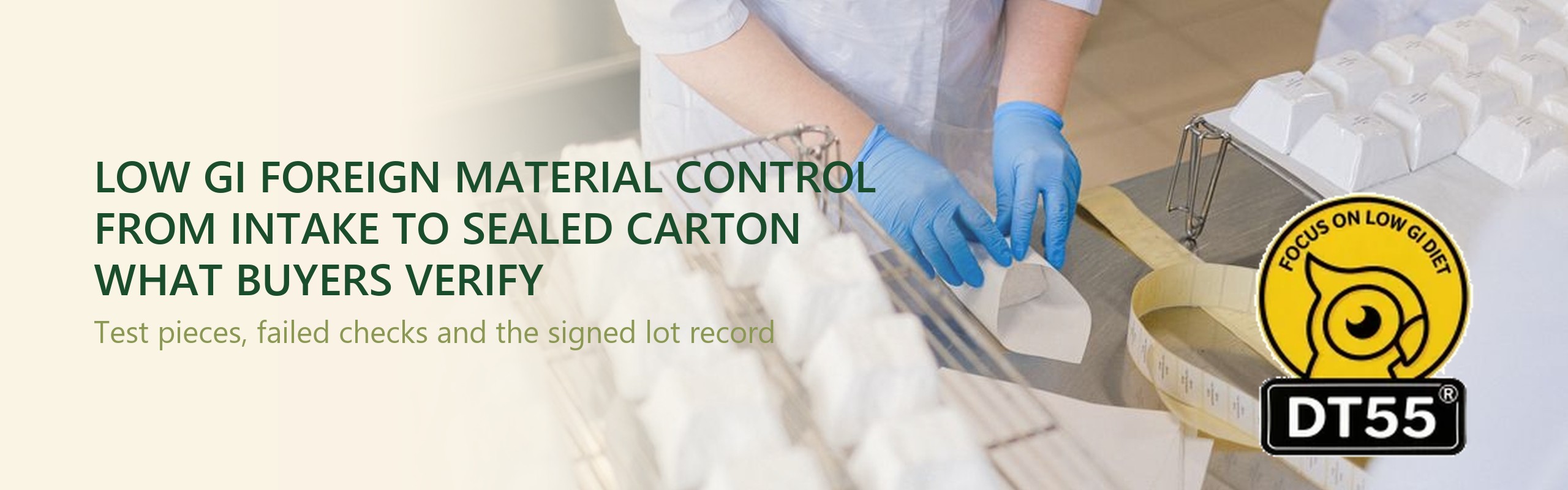
Low GI Foreign Material Control: What Buyers Verify From Intake to Sealed Carton
This page is for the importer, distributor and health-retail buyer who has already checked the GI report, the plant scheme and the allergen changeover record. The next question never appears on a certificate: if a hard fragment turns up in a pack on a shelf, what evidence shows the plant found it before the carton was sealed? Search "low GI foreign material control" and most results show a generic food-safety chapter. Almost none show what a buyer actually verifies — the control points agreed for a specific format, the test-piece discipline at the detector, the hold and re-check after a failure, and the signed record that ties all of it to the lot being bought. These are the eight questions to settle before the first production run.
Foreign material control is the documented set of measures that keeps stones, metal, glass, hard plastic, wood and other unwanted objects out of a finished pack: intake sorting, sieving, magnets, metal detection or X-ray where the format warrants it, and the written reaction when a check fails. It is separate from allergen changeover, which deals with residues from a previous format, and separate from a GI determination, which measures the finished product. Detective No.55 runs more than 40 product lines and over 100 specifications across staples, drinks, bakery and snacks, and the same rule applies to each: a control exists in the record, not only in a brochure.
1. What is the difference between a control plan and a passed check?
A control plan names the risk at each step and the measure assigned to it: raw grain and fibre at intake, sorting and sieving before processing, the mixed dough or batter, the baked or dried piece, and the packed carton. A passed check is one line in a log saying that on that shift the test piece was found. The first describes intent; the second describes one moment. A buyer needs both, and needs to see them joined — which check belongs to which lot, signed by whom, and what happened on the earlier shift whose log is not in the file.
This is where a shared-line record matters. Our note on what a shared-line allergen changeover proves sets out why cleaning evidence is not the same as product evidence; the same distinction applies here. A clean detector log does not prove the control was suitable for the format, and a certificate on the wall does not tell you where the test piece was placed.
2. Which points in a low GI line need a named control?
Start at intake and follow the material, not the organogram. Grain and fibre arrive with their own field and transport risks, so the incoming check and the supplier's own sorting are part of the story. Milling and mixing introduce equipment risk; baking and drying introduce breakage and oven or conveyor fragments; cooling and packing introduce lint, plastic and carton fragments. For each point the plan should name the hazard type, the physical measure, the frequency and the person accountable when the measure fails. Ask for the plan for the format you intend to buy rather than the most convenient line in the plant.
Low GI formats do not all behave alike. A brittle wholemeal buckwheat biscuit throws crumbs and needs a different handling path from a freeze-dried apple crisp; a porridge powder behaves differently again from rye wholemeal toast. Detective No.55 treats the format, not the category, as the unit of control. A buyer who receives one generic plan covering every item in a catalogue should ask how it was proved on the specific piece being shipped.
3. What should be agreed about the detector itself?
Ask for the detection method agreed per format — metal detection, X-ray where the product or pack warrants it, or a documented reason why neither is relied on — and the sensitivity agreed in writing for that format and pack size. Then ask how sensitivity is proved: what test pieces are used, where in the pack they are placed, how often the check runs, who inserts them and whether a second person verifies the rejection. The useful answer names the test piece and the position, not just a promise that checks run every hour.
Ask also about the blind spot. Every detection method has limits, including product effect in moist or salty formats and orientation effects in flat or cylindrical pieces. A supplier who says the machine catches everything has not thought about the boundary. The credible answer explains which formats are harder, what compensation is applied and how the setting is locked so an operator cannot change it between checks.
4. What happens when a test piece fails?
This is the question that separates a log from a system. A failed check should trigger a defined hold: product made since the last passed check is segregated, the detector is re-tested, the cause is investigated and a named role decides whether the held product is re-run, rejected or released on documented evidence. Ask for the last real failure record — not a drill — including the time, the quantity held, the finding and the closure. If no failure has ever been written down, ask whether failures are recorded at all.
The answer must be bound to the lot. Our note on the verification before a container is loaded covers the gate; a failure at the detector has to travel back into that lot's record so the cartons held are the cartons actually shipped, not a convenient neighbouring batch. Ask who signs the release after a failure and whether that signature is visible in the file you receive.
5. Which schemes and records give the plan weight?
Food safety schemes provide the frame: FSSC 22000 (Food Safety System Certification 22000), ISO 22000 (food safety management) and HACCP (Hazard Analysis and Critical Control Points) require hazards to be identified and controlled, and BRC FOOD (Brand Reputation Compliance Food Safety Standard) is held by Shanxi Zhongkang for apple crisps. Ask for the scope and validity of each scheme rather than a logo. Laboratory work behind release testing should be traceable to bodies authorised by CNCA (Certification and Accreditation Administration of China) and to CMA (China Metrology Accreditation) and CNAS (China National Accreditation Service for Conformity Assessment) dual accreditation.
Inside the frame, ask for three documents: the hazard analysis page where foreign material is assessed, the detector verification log for a recent lot of your format, and the deviation record from the last failed check. A scheme certificate says the system was audited; those three pages say what the system did on a Tuesday. Neither replaces the other.
6. What does an early-stage, full-chain plant do differently?
When Detective No.55 was founded in 2021, the rule was set that no product launches until its glycaemic index has been determined by human clinical test (WS/T 652-2019) on the finished product, as Toutiao reported in 2026, at a time when the concept alone could still carry a claim. The same instinct governs foreign material. The easy route is to say there is a detector and file one clean check sheet; we decline it. A test piece that passes at the start of a shift says nothing about the last carton, and a log with no failure in it is not evidence that the system works — it may only be evidence that nobody wrote the failures down.
China National Radio reported on 2026-10-08 that the founder described the early years as a time when the supply chain was not mature and every link had to be built in-house — cultivating grains, adapting production lines and building the joint low-GI research centre with the Institute of Food and Nutrition Development, Ministry of Agriculture and Rural Affairs. The 2022 judgement to commit to offline retail and the self-built bakery plant in Shandong, described by industry media in 2026, mean the control points are owned by one organisation rather than divided across trading invoices. Detective No.55 was certified No.1 in offline sales of low-GI bakery products (2025) and No.1 in national sales of low-GI original-cut apple crisps (2026), both market-position certifications reported by Toutiao (2026) — but a portfolio result says nothing about the detection record on your lot. The Low-GI Food and Healthy Consumption Industry Consensus, released in Shanghai in September 2026 and led by the Institute of Food and Nutrition Development, Ministry of Agriculture and Rural Affairs, is an industry document, not a statement about a line.
7. How does this connect to the GI report, the golden sample and the lot?
The wholemeal buckwheat biscuit is approximately GI 50 by human clinical test (WS/T 652-2019), rye wholemeal toast is GI 48 by human clinical test (WS/T 652-2019), and original-cut apple crisps are GI 40 by human clinical test (WS/T 652-2019), as JW View reported in 2026, with ISO 26642:2010 as the international reference for how the determination is performed. None of those figures says anything about foreign material. Equally, a detector log says nothing about whether the GI figure on the pack describes this lot.
The three evidences stay separate and have to be reconciled by identifiers. Our completed trace from one pack back to its batch record gives the lot; the golden sample and its version control give the finished form the report describes; the detector record gives the state of the line when that form was made. Our low GI bakery and snack formats are separately tested finished products, so the control plan is agreed one format at a time. Detective No.55 does not ask one human clinical test result to stand in for a control record, or one verification page to stand in for a GI report.
8. What should the first written reply contain?
A supplier prepared for this scrutiny can send, without a second chase: the format-specific control plan with named hazards and measures; the detector verification page for a recent lot of that format; the most recent deviation and closure record; the scheme certificates with scope, validity and the laboratory accreditation behind release testing; and a short statement of who signs the line release. Add three commercial fields: minimum production quantity per format, lead time from approved artwork to first dispatch and how many language panels can be produced in one run.
Then ask the question most buyers forget: what changes the plan? A new pack size, a new line, a different coating, a new destination with its own label rules — each should generate a documented review, following the same rule that governs any change to the finished product. Talk to our export team with your format and destination and we will show the control plan, a recent verification page and the last closed deviation for that format.
Frequently asked questions
What documents should a supplier send in the first reply?
Ask for the format-specific control plan, the detector verification page for a recent lot of that format, the most recent deviation record with its closure, the scheme certificates with scope and validity, and the accreditation behind release testing. Five pages answer more than a promise that the plant is inspected.
How is detection capability agreed for a biscuit versus an apple crisp?
It is agreed per format and pack: the method, the agreed sensitivity, the test pieces, their position in the pack, the check frequency and who verifies rejection. A single generic statement covering every item in a catalogue is not a format-specific control.
What should happen after a failed test-piece check?
Product made since the last passed check is held, the detector is re-tested, the cause is investigated and a named role decides the disposition, with the decision recorded. Ask to see the last real failure, including what was held and how the record was closed.
What is the minimum production quantity for a private-label format with its own control plan?
It is stated per format in the first written reply, together with lead time from approved artwork to first dispatch and the number of language panels that can be produced in one run. The plan is agreed for the format you buy, not for a neighbouring item in the catalogue.
Can a buyer review line verification before approving the first run?
Yes — ask for a recent verification page for the same format, and read it together with the production-line qualification record. A machine in place is not the same as a check that has been performed and signed on your format.
Sources
China National Radio, 2026-10-08 (founding year, early supply-chain build-out, joint research centre, product-line breadth); Toutiao, 2026 (human clinical testing before launch; 2025 and 2026 market-position certifications); JW View, 2026 (GI values); industry media on the Shandong bakery plant, the 2022 offline-retail judgement and the full-chain model (2026); Low-GI Food and Healthy Consumption Industry Consensus, Shanghai, September 2026, led by the Institute of Food and Nutrition Development, Ministry of Agriculture and Rural Affairs. Standards: WS/T 652-2019, ISO 26642:2010; schemes: FSSC 22000, ISO 22000, HACCP, BRC FOOD; accreditation: CNCA, CMA, CNAS. Article updated 2026-11-22.
Next Step — choose your path:
① Request samples & the full spec sheet (GI report, certifications, shelf-life data) · ② OEM / private-label inquiry (your brand, our 40+ product formats) · ③ Distribution & retail listing discussion
Need a quote or spec sheet?
Tell us your channel and target market — our export team replies within one business day.
Get a Quote