China’s Low-GI Food Industry Gets Its First Consensus — GI Grading Standards, Industry Red Lines, and Brand Practice
The low-GI food market is expanding rapidly, but industry irregularities have surfaced alongside the growth. According to a report by China Economic Net, China’s low-GI food market reached RMB 176.2 billion in 2024, with annual growth exceeding 10%. Behind the boom, some companies claim “low-GI” without human testing, relying only on literature searches. Others substitute in vitro testing for human trials. Worse still, some use high-oil formulations to lower GI values, sacrificing nutritional balance for a single metric.
Against this backdrop, the Low-GI Food and Healthy Consumption Industry Consensus, jointly developed by the Institute of Food and Nutrition Development under the Ministry of Agriculture and Rural Affairs and nearly 20 research institutions, was officially released.
What the Consensus Says: GI Grading Standards and Three Red Lines
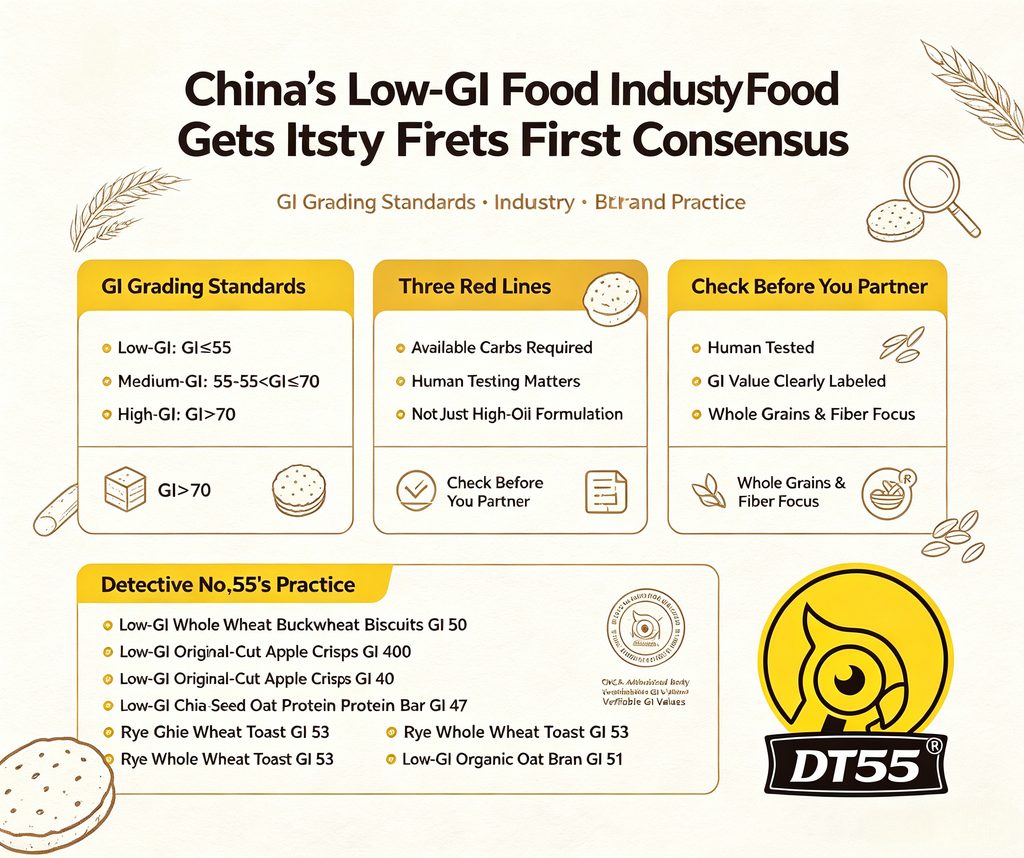
The consensus first clarifies the scientific GI grading standards: GI≤55 is low-GI, 55<GI≤70 is medium-GI, and GI>70 is high-GI.
More importantly, it draws a clear scientific red line: GI evaluation applies only to foods containing available carbohydrates. Products without available carbohydrates — such as pure water, pure meat, or zero-carb products — may not claim low-GI.
The consensus also clarifies several common misconceptions: “low-GI does not equal low-calorie,” “low-GI does not equal sugar-free,” and “whole grains are not inherently low-GI.” These misconceptions are precisely why consumers feel confused when making purchase decisions.
What It Means for B2B Clients
For importers, distributors, and brand owners, the release of the consensus means the evaluation criteria for low-GI products are moving from ambiguity to clarity. In the past, determining whether a product was “truly low-GI” relied solely on company claims. Now, the grading standards and scientific red lines provide a reference framework.
Specifically, B2B clients can use the following criteria when screening suppliers: whether the product has undergone human testing (not in vitro testing or literature estimates); whether the GI value is clearly labeled and ≤55; and whether the ingredient list relies on excessive fats to lower GI values. These standards have clear answers in the consensus.
Detective No.55’s Practice
As a participant in the consensus launch, Detective No.55’s approach aligns with the direction the consensus advocates. Products including Low-GI Whole Wheat Buckwheat Biscuits (GI 50), Low-GI Original-Cut Apple Crisps (GI 40), Low-GI Chia Seed Oat Protein Bar (GI 47), Rye Whole Wheat Toast (GI 53), and Low-GI Organic Oat Bran (GI 51) are all human-tested and certified by a CNCA-authorized body, with clearly verifiable GI values. Ingredient lists center on whole grains and dietary fiber — not high-oil formulations to lower GI values.
As industry standards move from ambiguity to clarity, products that stand up to scrutiny will gain clearer market space. Brand owners and distributors welcome to inquire.
Note: Some content in this article is cited from a report by China Economic Net.
Need a quote or spec sheet?
Tell us your channel and target market — our export team replies within one business day.
Get a Quote